czwartek, 26 grudnia 2013

MUST SEE: St Johns' Cathedral

The construction of the cathedral started in mid – 13th century and was continued in stages for over 200 years. It is the biggest and oldest of all town’s churches. Among its rich interior decorations, of particular importance are the main altar with Saint Wolfgang created in years 1502-1506, valuable wall paintings and baroque and rococo altars. There is also a medieval font in which Nicholas Copernicus was baptized. On the tower opened for sightseeing there is a gothic bell Tuba Dei and a clock called “rafters’ clock”, which shows time with only one hand.


Tuba Dei Bell (God’s Trumpet) was cast in 1500 in bronze with  an addition of silver and gold. It is the biggest medieval bell in Poland and it weighs about 7,5 tones. According to the legend, in order to place the bell on the tower, a 800 meter ramp was built over the roofs of houses and seven fine oxen pulled it up. In the old times, the sound of the bell welcomed monarchs visiting Torun. Nowadays, it honors all the most important church ceremonies.

wtorek, 3 grudnia 2013

Torun's authorities

Basic issues of the system were regulated by the charter of Chelmno, granted in 1233 and renewed in 1251, as well as by the law of Magdeburg.

Initially, the most important decisions concerning the functioning of the city were made by the assembly of citizens, made up by the inhabitants of Torun, who had full city rights. Every year the community of burghers chose the judge, also called the city leader (soltys), and his candidacy was accepted by the Teutonic Knight Order. Soltys along with the jurymen made the jury. In Torun it was appointed in the charter of Chelmno probably soon after 1233, although the first mention about its functioning dates back to 1258. Since the beginning of the 14th century the number of jurymen of the Old Town of Torun was set at 12. 
Firstly, it was the jurymen themselves who decided on the appointment of the new members of the jury. However, it was already at the turn of the 13th and 14th centuries that the city council got the decisive influence in this matter.

At first, gatherings of the jury were held in the open air on the biggest market place in the city. The gatherings were open and usually attracted a significant number of spectators. Most probably in 1274 the building of the court was erected. After the Town Hall had been extended in 1393, the gatherings were moved to its northern wing. The jury was responsible for adjudicating in all civil and criminal cases. In the Old Town of Torun the jury books had been kept since 1363, and previously so called jury lists, which apart from the list of jurymen contained court sentences. The jury of the Old Town of Torun comprised the city territory within the city walls as well as patrimonium (the land possessions of the city).

The city council of Torun came into existence most probably between 1233 and 1251. At the beginning of the city it was soltys with the jury who held the broadest range of power, however the council was gradually gaining more and more competences. The furthest going changes had place at the turn of the 13th and 14th centuries, when the council acquired a significant privilege of appointing the jurymen and soltys, and at the same time took over some of his competences. In the second half of the 13th century it was the council which represented the city and delegated its representatives to meetings with the Grand Master and the Association of the Hanza Cities. As a result of these system changes the council had become the most important organ of authority. It held the supreme legislative, executive, and judicial authority. One of its most significant privileges was to issue "wilkierze", i.e. directives regulating the city life. The executive authority meant the general administration over the city. The council was also responsible for the implementation of orders issued by the state authorities.

Initially, the assembly of citizens had decisive influence on the election of the councilors. However, soon the council expanded its competences, and acquired the full right to elect its members. Election of new councilors was already held in a parish church on the 22nd of February, when the Catholic church celebrates the holiday of the Cathedral of St. Peter. Since the beginning of the 14th century the council of the Old Town of Torun had consisted of the incumbent council (the councilors currently holding the clerical posts in the city) and the council of the elders, namely the body consisting of the councilors of “previous terms”. As a whole the number of the councilors was not permanent, and varied between 24 and 25. The councilors originated most often from well off merchant families, and even though legally representatives of some crafts were allowed to held the post it happened hardly ever. Families that had direct influence on the authorities in the city made the patriciate, the group distinguished not only by its wealth but family and economic connections.


At the head of the council was a mayor, who led its meetings, along with it represented the city outside, and was responsible for the city treasury and its seals. The post of the mayor was first mentioned in the document from 1303. Initially, two mayors were elected, since one was at the head of the incumbent council, and the other led the council of the elders. In the 40s of the 14th century the number of mayors increased to four, because the posts of deputies were created. 

In 1264 another town was erected not far from Torun. The country Master th March 1454. Then the council of the New Town of Torun ceased to exist, yet the difference in judiciary system was still preserved.
Ludwik von Baldersheim granted the charter to the New Town of Torun. It was based also on the charter of Chelmno, and had similar system rules to the ones in the Old Town. Analogically, it was ruled by the council and the jury. However, its founder, namely the Teutonic Knight Order, granted itself a significantly bigger influence on the life of the city. The system differences were cancelled in the act of incorporation signed on the 8


niedziela, 17 listopada 2013

Torun's development


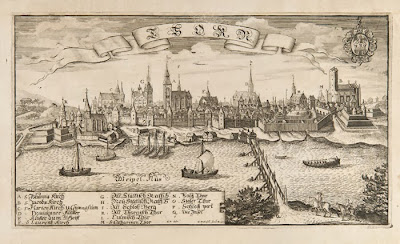
In 1231 the Teutonic Knights set up a stronghold and a town near the crossing on the Vistula, where the village of Stary Torun is nowadays. These were, however, flood lands, which soon resulted in moving the town and the castle to their present locations. The main road of a newly established town was the street of St Ann (today ul. Kopernika). On the central square market facilities were built as well as a parish church, which was located on the area of the chancel of today’s church of St John’s. in 1239 the representatives of the Franciscan order came to Torun. Soon, they started the construction of their monastery in the northern-west part of the town. At the beginning of the second half of the 13th century the idea of the town layout changed. Where the market square is today the merchants house was erected the earliest (1259), acting as cloth stalls, and later on bread stalls, the tower of the Town Hall, the house of weight, the building of the proper Town Hall, where the town council met. After the seat of jury court had been erected all of these buildings made a four-wing construction with a closed yard and two passages. In 1391 (the privilege from 1393) they began the construction of the new Town Hall. In 1399 the keys to the new Town Hall were passed to the mayor. From the side of the land the town was moated, with the double defense walls (low and high) and 4 gates and towers; from the side on the Vistula it was protected by a single high wall and 4 gates.

In the 50s of the 13th century east of the town, on the post-Slavic site, the Teutonic Knights started to erect a castle. The walls surrounding it were in an unusual shape of a horseshoe, whose arms were directed towards the Vistula. Northwards of a stronghold was a forecastle, and eastwards was so called wola zamkowa, where firewood was piled, household animals were kept, and servants of the Order lived.
On 13th August 1264, next to a fast developing town, the Teutonic Knights set up the New Town of Torun, surrounded with defense walls, with six gates leading to it. The regular line of buildings was disturbed by the Dominicans, who came to Torun in 1263 and erected their monastery in the northern-west part of the New Town of Torun. Similarly, the street called Wielkie Garbary was set according to the important trade route towards Dobrzyn.

Most probably not later than in 1309 the construction of a parish church of St. John began in the eastern part of the town. New Town had remained separated by 1454, when it got incorporated in the Old Town.
Patrimonium (land possessions) of the Old Town of Torun were determined in the charter. Primarily these were only five islands with a joint area of 10 łany, yet already in the renewed charter of Torun from 1st October 1251 the Teutonic Knights Order had significantly expanded the lands of the town, which made a strip of land 1,6 km long down the Vistula from the lands belonging to the bishop of Włocławek, and 0,5 km wide from the river bank. Its area was 180 łany, which means 30 square kilometers. The extension of the land remuneration resulted from the dynamic development of the town, as well as from renewing its chart. In the following years the area of patrimonium had changed many times as a result of the negotiations between the citizens and the Order, and it was only at the beginning of the 14th century that its limits had finally been fixed. The land possessions of the town covered the area of 335 łany, which is around 56 square kilometers. Part of this area was occupied by the suburbs.


The oldest of the suburbs of the Old Town, called the harbor suburb, stretched on the Vistula, along the town walls, and included Kępa Bazarowa. From the eastern as well as the western side it was limited by the branches of Postolsko channel. The development of this suburbs was strictly connected with the needs of  the harbor of the town. There were port facilities, cloth stalls, several granaries, baths, a tavern and hospital of Holy Spirit. The area was inhabited mainly by fishermen, sailors, porters, and shipwrights. To the west and north of this suburb, along the Vistula, were hardly inhabited areas. There were mostly vegetable gardens, limestone site, and shipyard and brickyard, around which a settlement of port makers, attic makers, and stone-workers arose. 

The most important suburb, when it comes to population and economy, was on the north of the walls of both Old and New Towns of Torun, along the road to Chełmno. It was already in the first half of the 14th century that in Chełmińskie suburb a lot of craftsmen settled down. The area was most densely populated around two churches: of St. Laurance and St. George. On the northern east of this suburb two ponds were made, on which watermills, a sawmill and a copper mill were built. At the Chełmińska gate two markets were located: horse and cattle and numerous stalls. There was also a second brickyard in Toruń. 

To the north and northern east of the suburb there was so called Wielkie and Małe Mokre, including mainly vegetable gardens, vineyards as well as farmlands. 

To the east of the New Town of Torun a small suburb of St. Catherine appeared. Life focused there around the chapel of St. Catherine, erected around 1360 and around a slaughterhouse. Eastwards, along the Vistula, a scarcely populated suburb called Jakubskie arose. There timber was piled and a shipyard and carpenter’s shop were set up. Around in there were gardens and vineyards. 


wtorek, 20 sierpnia 2013

MUST SEE: The Leaning Tower

According to the legend, this medieval fortified tower was built by a Teutonic knight from Torun as a penalty for committed sins. The building, with a vertical deviation of 146 cm, was a part of old Torun’s fortifications. After it ceased to play a defensive role, it was a seat of a locksmith, a prison for woman, now it is an important point of eve
ry sightseeing trip. Inclined more than the tower in Piza.

wtorek, 13 sierpnia 2013

MUST SEE: Saint Mary’s Church


This gothic church was built by Franciscan friars in 14th century. According to the severe principle of the convent, which demands a life in poverty, the church does not have a tower nor rich architectural decorations. It is one of the most outstanding sacral and architectural achievements in Poland. In the 14th century it was the highest church in Central Europe with the naves almost 30 meters high.

Inside there are wooden stalls from early 15th century, intricately crafted pulpit, organs, medieval paintings and epitaphs of fine Torun families. In 1636, Anne Wasa, a sister of a Polish king Sigmund Wasa III, was buried there.

poniedziałek, 29 lipca 2013

The guilds of craftsmen

The first guilds of craftsmen appeared in Torun soon after it had received its charters. The first to set up their guilds were food craftsmen: bakers, butchers, as well as still merchants, and shoemakers, including tanners. Between 1235 and 1255 there were four guilds of craftsmen in the Old Town of Torun.

In 1259 a merchants house was built in the place where the western wing of the Old Town Hall is today. It was a one-floor building, which served as a cloth stall. It is at this time probably that the guild of cloth makers emerged. Soon afterwards (1274) the burghers of Torun acquired the right to build stalls and bread stalls. th century the cloth makers one. A guild was to protect the economic interest of its members. Guilds also controlled the quality of production as well as the education of craftsmen. Additionally, they also provided supplies for workshops. Moreover, guilds had the role of religious corporations and mutual aid organizations. Richer  guilds owned their  chapels or altars. Town authorities made guilds. In 1398 in the Old Town of Torun there were already 41 guilds, including for example leather makers, comb makers, needle makers, hatters, sausage makers, wheel makers, pot makers, blacksmiths, belt makers, bakers, brewers, linen makers, glove makers, butchers, saddle makers, shoemakers, glaziers, locksmiths, purse makers, and goldsmiths. Being a member of a guild started from apprenticeship. Approximately it lasted from 2 to 5 years. Master’s son was released from the lowest level of training. An apprentice didn’t get any pay for the period of training, however got bed and board.
Then, most probably, the guilds of linen craftsmen, furriers, shield makers, and leather workers emerged. The process of establishing guild structures in the New Town of Torun was similar. There the first to emerge were the guilds of butchers and bakers, and at the end of the 13th century the cloth makers one. A guild was to protect the economic interest of its members. Guilds also controlled the quality of production as well as the education of craftsmen. Additionally, they also provided supplies for workshops. Moreover, guilds had the role of religious corporations and mutual aid organizations.

Richer  guilds owned their  chapels or altars. Town authorities made guilds. In 1398 in the Old Town of Torun there were already 41 guilds, including for example leather makers, comb makers, needle makers, hatters, sausage makers, wheel makers, pot makers, blacksmiths, belt makers, bakers, brewers, linen makers, glove makers, butchers, saddle makers, shoemakers, glaziers, locksmiths, purse makers, and goldsmiths. Being a member of a guild started from apprenticeship. Approximately it lasted from 2 to 5 years. Master’s son was released from the lowest level of training. An apprentice didn’t get any pay for the period of training, however got bed and board.

Having completed the training an apprentice was qualified as a journeyman. From that moment on he had the right to get  paid for his work. Besides, he could be judged and punished by guild authorities only, while an apprentice was totally subordinated to the judgment of his master.
The differences when it comes to wealth were not only visible within a particular guild, but also between trades. At the turn of the 14th and 15th centuries brewers, goldsmiths, and leather makers were the most affluent ones.